English
 русский
 Español
News
Home / News / Industry News / What’s the Difference Between SD and HD Encoder Series Headend Equipment?

Welcome to Prevail Website! Optical Communication Equipment Manufacturers and Suppliers in China

Content
Headend equipment plays a critical role in the distribution of television and video content over cable, IPTV, and satellite networks. Among these devices, SD (Standard Definition) and HD (High Definition) encoder series are essential for converting raw video signals into a format suitable for transmission and broadcast. Understanding the differences between SD and HD encoder series headend equipment is vital for operators, engineers, and network designers to ensure optimal video quality, bandwidth efficiency, and system compatibility. This article examines the technical distinctions, operational considerations, and practical applications of SD and HD encoders in modern broadcasting networks.
Encoder series headend equipment is designed to process incoming video signals from various sources, including satellite feeds, cameras, or stored media. The encoders compress and convert these signals into digital streams for distribution to end users via cable, fiber, or IP networks. SD and HD encoders differ primarily in resolution, compression algorithms, and output quality. While SD encoders handle lower resolution signals, HD encoders are designed for higher resolution content, supporting 720p, 1080i, and 1080p formats commonly used in modern broadcasting.
The most obvious difference between SD and HD encoders is the supported resolution. SD encoders typically handle 480i or 576i resolution, suitable for standard definition broadcasts. HD encoders, on the other hand, manage higher resolutions such as 720p, 1080i, and 1080p. This difference impacts the sharpness, clarity, and overall visual experience for viewers.
Higher resolution signals processed by HD encoders require more advanced compression techniques and greater bandwidth. Therefore, network designers must ensure that distribution infrastructure, including headend bandwidth and set-top boxes, is compatible with HD content to maintain signal integrity.
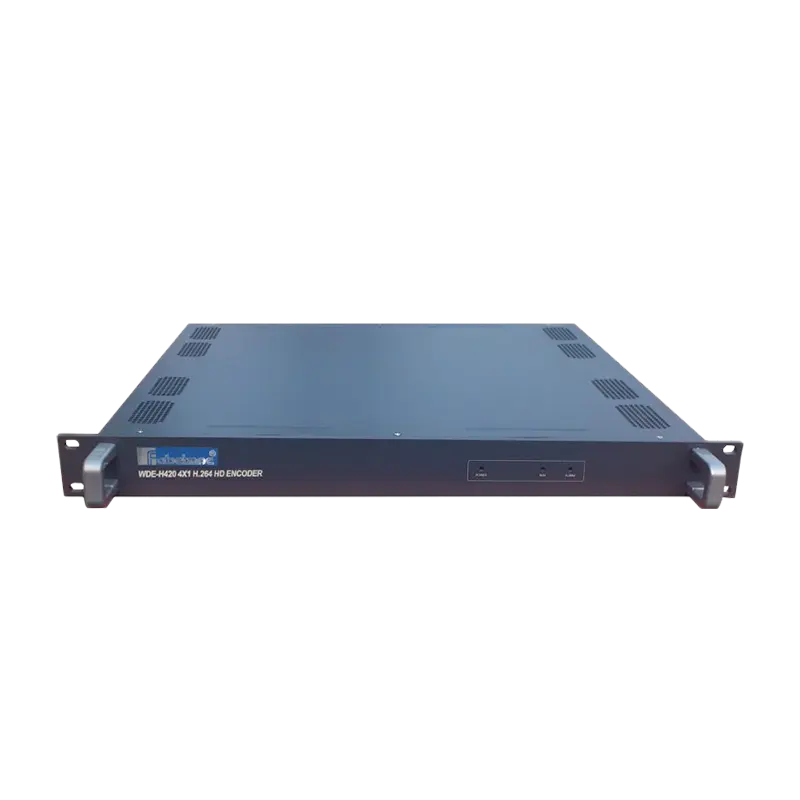
SD and HD encoders use different compression algorithms to balance video quality with bandwidth efficiency. Common standards include MPEG-2 and H.264 (AVC). SD encoders often rely on MPEG-2, which provides sufficient quality at lower resolutions with minimal bandwidth. HD encoders, however, typically use H.264 or HEVC (H.265) to compress higher resolution content effectively while conserving bandwidth.
Bitrate requirements also differ significantly. An SD channel may require 2-4 Mbps for good quality, whereas an HD channel can require 5-10 Mbps or more, depending on compression efficiency. Selecting the appropriate encoder ensures efficient use of network resources while maintaining acceptable video quality.
In addition to video, encoders manage audio streams. SD encoders generally support stereo audio channels, while HD encoders often accommodate multi-channel audio, including Dolby Digital 5.1 or 7.1 formats. This capability enhances the viewer experience by providing surround sound and richer audio fidelity, especially important for cinema-quality broadcasts and high-end IPTV services.
HD encoders typically introduce slightly higher latency compared to SD encoders due to increased processing demands. While SD encoders can process and transmit standard definition content almost in real time, HD encoders must handle larger data streams and complex compression algorithms. For live broadcasts, network engineers must consider encoder latency and ensure synchronization with other headend devices to avoid buffering or audio-video misalignment.
HD encoder series generally require more advanced hardware, including faster processors, larger memory, and improved heat dissipation systems. They may also support additional features such as adaptive bitrate streaming, dual encoding for SD and HD output, and integrated IP multiplexing. SD encoders are simpler and cost-effective, suitable for networks that do not require high-definition content.
When integrating encoders into a headend setup, engineers must consider existing infrastructure compatibility. HD encoders may necessitate upgraded switches, distribution amplifiers, and monitoring equipment to handle the increased data load.
Because HD encoders handle larger data streams and more complex processing, they consume more power than SD encoders. Higher energy consumption translates into increased operational costs for data centers and broadcasting facilities. Network operators must balance the benefits of HD content with energy efficiency, especially in large-scale deployments with dozens or hundreds of channels.
| Feature | SD Encoder | HD Encoder |
| Resolution | 480i / 576i | 720p, 1080i, 1080p |
| Compression | MPEG-2 | H.264 / HEVC |
| Bitrate | 2-4 Mbps | 5-10+ Mbps |
| Audio | Stereo | Multi-channel / Dolby Digital |
| Hardware | Basic processor, low memory | High-performance processor, advanced features |
| Power Consumption | Low | Higher |
HD and SD encoder series headend equipment serve distinct purposes in broadcasting networks. SD encoders are cost-effective, energy-efficient, and sufficient for legacy or standard definition content. HD encoders provide superior visual and audio quality, supporting modern broadcasting standards and high-resolution video delivery. Selecting the appropriate encoder depends on network requirements, budget, infrastructure compatibility, and the desired viewer experience. By understanding the differences, network operators can design scalable, efficient, and high-quality video distribution systems for both current and future demands.
top

E-mail:[email protected]

Telphone:+86-15967387077

FAX:+86-0571-82554407

Phone:+86-15967387077
QR code on
mobile phone