English
 русский
 Español
News
Home / News / Industry News / How does a 1550nm directly modulated optical transmitter differ from externally modulated systems?

Welcome to Prevail Website! Optical Communication Equipment Manufacturers and Suppliers in China

Content
In modern fiber-optic communications, optical transmitters are critical components for transmitting data over long distances with minimal loss. Among these, 1550nm wavelength systems are widely used due to low fiber attenuation and compatibility with standard single-mode fibers. Optical transmitters can be classified as directly modulated or externally modulated, each with distinct operational principles and application advantages.
Understanding the differences between directly and externally modulated 1550nm transmitters is essential for network designers, engineers, and system integrators who aim to optimize performance, reliability, and cost in optical networks.
A 1550nm directly modulated optical transmitter (DM-OTX) modulates the intensity of the laser light directly by varying the injection current of the laser diode. The electrical data signal drives the laser, producing optical pulses that correspond to digital 0s and 1s. This approach simplifies the design, reduces component count, and lowers cost, making DM transmitters suitable for short to medium-haul applications.
However, directly modulated lasers face intrinsic limitations such as chirp—a frequency variation associated with intensity modulation—which can lead to signal dispersion over long distances, limiting the effective transmission span without additional dispersion compensation.
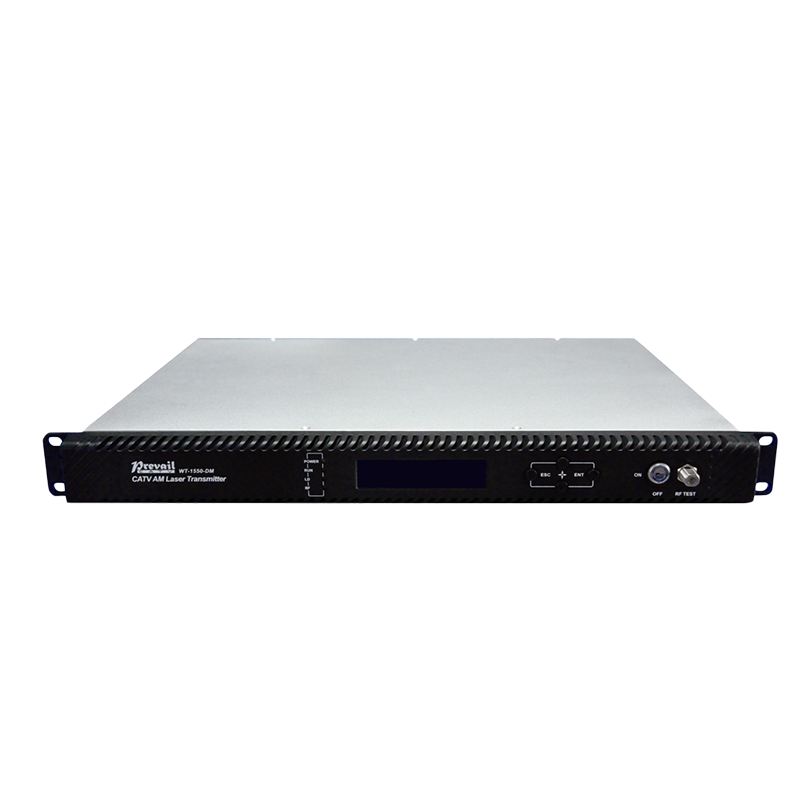
Externally modulated optical transmitters (EM-OTX) operate by using a continuous-wave (CW) laser and an external modulator, typically a Mach-Zehnder modulator (MZM), to encode the data onto the optical carrier. This approach separates the laser generation from the modulation process, minimizing chirp and enabling higher-speed transmission with reduced dispersion penalties.
External modulation provides superior signal integrity over long-haul networks, dense wavelength division multiplexing (DWDM) systems, and high-speed metro and backbone networks, but it comes at a higher cost and increased complexity compared to direct modulation.
| Parameter | Directly Modulated | Externally Modulated |
| Chirp | High | Low |
| Maximum Data Rate | ≤10 Gbps | ≥40 Gbps |
| Transmission Distance | Short to Medium (≤80 km) | Long Haul (≥100 km) |
| Cost | Lower | Higher |
| Complexity | Simple | Higher |
Directly modulated 1550nm transmitters are commonly used in access networks, CATV systems, and short-haul metro links where cost efficiency and moderate transmission distances are priorities. They are suitable for passive optical networks (PONs) and simple point-to-point links.
Externally modulated transmitters, on the other hand, are ideal for long-haul telecom, DWDM backbone networks, submarine systems, and high-speed data center interconnects. The reduced chirp and enhanced signal quality allow for extended reach and higher spectral efficiency.
Network engineers must consider the trade-offs between cost, transmission distance, data rate, and environmental conditions when selecting between directly and externally modulated 1550nm transmitters. Key factors include fiber type, chromatic dispersion, required optical power, and system scalability.
Direct modulation is preferred for cost-sensitive, shorter links, while external modulation is the choice for long-haul, high-speed, and DWDM-enabled networks where performance cannot be compromised.
1550nm directly modulated and externally modulated optical transmitters serve different roles in fiber-optic networks. Direct modulation offers simplicity, cost-effectiveness, and suitable performance for short to medium distances, while external modulation provides superior signal integrity, long-haul capability, and high-speed support for backbone networks.
Choosing the right transmitter depends on application requirements, network design, and budget considerations. Understanding the technical differences ensures optimal system performance, minimal signal degradation, and efficient deployment of modern fiber-optic communication networks.
top

E-mail:[email protected]

Telphone:+86-15967387077

FAX:+86-0571-82554407

Phone:+86-15967387077
QR code on
mobile phone