What’s the Difference Between 1310nm and 1550nm Optical Transmitters?
Understanding the Core Differences Between 1310nm and 1550nm Optical Transmitters
Optical fiber communication relies heavily on the selection of wavelength, and the most commonly compared choices are 1310nm and 1550nm optical transmitters. Although both wavelengths support high-quality data transmission over single-mode fiber, they perform differently in terms of attenuation, dispersion, transmission distance, compatibility, and cost. Understanding these differences is essential for engineers designing long-haul, metro, or access-level networks.
Why Wavelength Matters in Fiber Transmission
The wavelength of an optical transmitter determines how light behaves inside the fiber. Different wavelengths experience different attenuation and dispersion characteristics, which directly affect signal reach and stability. The 1310nm and 1550nm windows are considered optimal because fiber attenuation is significantly lower compared to other wavelengths. However, “optimal” does not mean identical; each wavelength offers unique advantages depending on the application, distance, and system design.
Attenuation and Signal Loss
One of the most critical performance differences is attenuation. At 1310nm, typical fiber attenuation is around 0.35dB/km, while at 1550nm it drops to approximately 0.20dB/km. This reduction makes 1550nm transmitters much more suitable for long-distance communication. In practical terms, a lower attenuation rate means the optical signal can travel farther before the need for amplification or regeneration.
Chromatic Dispersion Differences
While 1310nm benefits from minimal chromatic dispersion, 1550nm experiences much higher dispersion, especially in standard single-mode fiber (G.652). Chromatic dispersion spreads the optical pulse over time, limiting data transmission rate and distance unless dispersion compensation is introduced. For short and medium distances, the low dispersion at 1310nm can be an advantage. For high-capacity long-haul networks, 1550nm systems use dispersion-shifted fiber or compensation modules to handle this challenge effectively.
Comparing Technical Performance: 1310nm vs 1550nm
The following table summarizes the most important technical differences between 1310nm and 1550nm optical transmitters. These distinctions determine suitability for long-haul systems, metro networks, PON deployments, and CATV transmission.
| Parameter |
1310nm Transmitter |
1550nm Transmitter |
| Fiber Attenuation |
~0.35 dB/km (higher loss) |
~0.20 dB/km (lower loss) |
| Chromatic Dispersion |
Very low |
High in G.652 fiber |
| Typical Transmission Distance |
Short–Medium range |
Long or ultra-long range |
| Cost Level |
Lower |
Higher |
| System Compatibility |
Common in legacy networks |
Used in DWDM/PON/CATV |
Application Scenarios of 1310nm vs 1550nm Transmitters
Beyond technical specifications, real-world applications influence wavelength choice. Both 1310nm and 1550nm wavelengths are integral to modern fiber communication, but they serve different roles based on the distance, bandwidth, and type of optical components in the system.
Where 1310nm Transmitters Are Commonly Used
1310nm optical transmitters are widely adopted in short- to medium-distance communication, especially where dispersion must be minimized. These systems often do not require expensive amplifiers or dispersion compensation modules, making them ideal for cost-sensitive network deployments. Examples include campus networks, intra-city fiber, and legacy SONET/SDH systems. Additionally, many data centers still rely on 1310nm optics for its simplicity and low dispersion performance.
Where 1550nm Transmitters Are Preferred
1550nm transmitters dominate long-distance optical communication because of their low attenuation and compatibility with EDFA optical amplifiers. They are commonly used in backbone networks, fiber-to-the-home (FTTH) systems, CATV broadcasting, and DWDM long-haul transmission. With the support of EDFA, a 1550nm signal can travel hundreds of kilometers without electrical regeneration, making it the backbone of modern high-capacity networks.
Compatibility With Optical Amplifiers and Passive Components
A significant advantage of the 1550nm wavelength is its compatibility with Erbium-Doped Fiber Amplifiers (EDFA), one of the most important technologies in long-haul optical networks. EDFAs amplify the signal directly in the optical domain without converting it back to electrical form. In contrast, 1310nm wavelengths cannot benefit from standard EDFA amplification, limiting their reach in long-distance transmission.
Impact on Network Cost and Complexity
Although 1550nm systems offer superior distance and capacity, they often require higher initial investment. Amplifiers, dispersion compensation modules, and DWDM components add complexity to system design. Meanwhile, 1310nm transmitters allow for simpler and more affordable deployments. For access networks or short metro routes, this cost advantage is a major decision factor.
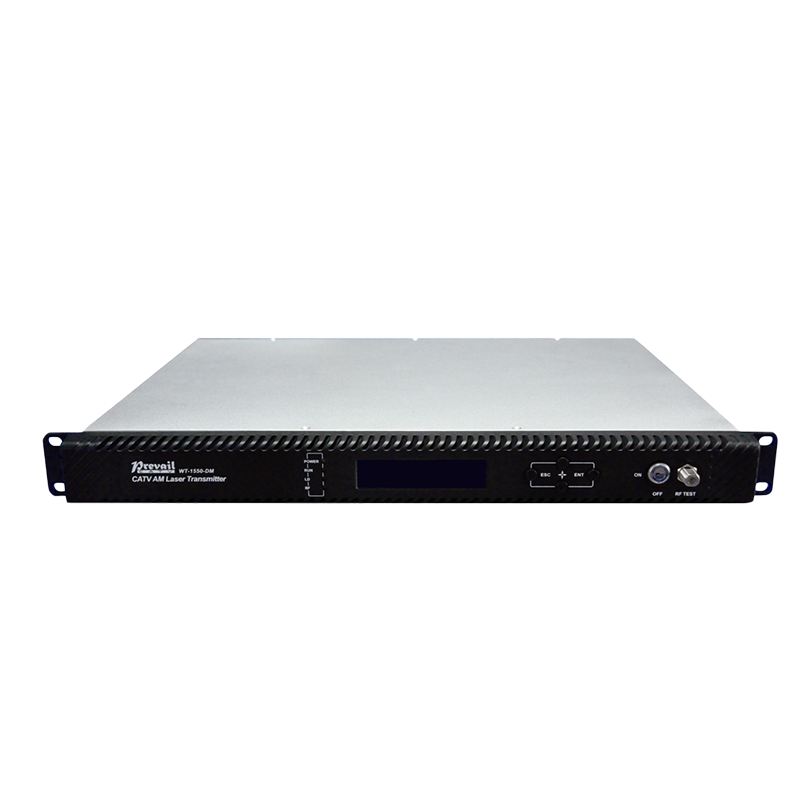
How to Choose Between 1310nm and 1550nm Optical Transmitters
Network designers must weigh distance, bandwidth, cost, and component compatibility. For example, if the link spans only a few kilometers and does not require high data rates, a 1310nm transmitter may be both cost-effective and efficient. However, if the objective is long-distance transmission, especially where DWDM or CATV overlay networks are involved, 1550nm is overwhelmingly preferred.
- Choose 1310nm for low-cost, short to medium fiber runs with minimal dispersion concerns.
- Choose 1550nm for long-haul, high-capacity systems supported by EDFA amplification.
- Consider network components such as DWDM modules, amplifiers, and dispersion compensation devices.
- Evaluate the total cost of ownership, not just the price of the transmitter.
Conclusion: Which Wavelength Is Better?
Neither 1310nm nor 1550nm transmitters are inherently “better”—instead, each serves a specific purpose. The 1310nm wavelength is ideal for simpler, shorter-range links with low dispersion requirements. Meanwhile, 1550nm dominates long-distance, high-capacity optical networks due to its low attenuation and support for EDFA. Understanding these differences allows network designers and engineers to select the most appropriate wavelength for their system’s performance goals and cost constraints.


 English
 русский
 Español