English
 русский
 Español
News
Home / News / Industry News / How to Choose the Right 1310nm Optical Transmitter for Long-Distance Communication?

Welcome to Prevail Website! Optical Communication Equipment Manufacturers and Suppliers in China

Content
1310nm optical transmitters are a critical component in fiber optic communication networks. They operate at a wavelength of 1310 nanometers, which is optimal for long-distance transmission due to low dispersion and attenuation in standard single-mode fibers. Selecting the correct transmitter ensures minimal signal loss, high reliability, and cost efficiency in network deployment.
When evaluating 1310nm optical transmitters, several technical specifications must be assessed to match your communication requirements. Understanding these parameters helps in making an informed decision for long-distance applications.
The optical output power, measured in dBm, indicates the strength of the light signal emitted by the transmitter. For long-distance communication, a higher output power can help overcome fiber loss and maintain signal integrity. Typical 1310nm transmitters have output powers ranging from -3 dBm to +10 dBm. Always ensure the output power matches the link budget of your system.
Receiver sensitivity defines the minimum optical power the receiving device can detect and convert into a usable electrical signal. When selecting a transmitter, ensure the combination of transmitter power and receiver sensitivity accommodates the distance and fiber losses to prevent errors or signal degradation.
1310nm optical transmitters are often used for medium to long-distance communication, typically ranging from 10 km to 80 km or more depending on fiber quality and system design. Confirm the maximum transmission distance supported by the transmitter and calculate the total link loss including splices, connectors, and fiber attenuation.
The type of modulation affects the data rate and distance performance. Common modulation techniques include NRZ (Non-Return-to-Zero) and RZ (Return-to-Zero). NRZ is widely used for long-distance links due to its simplicity and compatibility with high-speed data transmission.
1310nm transmitters are available in two main types: Distributed Feedback (DFB) and Fabry-Pérot (FP). Each type has distinct advantages and applications.
DFB transmitters provide a narrow linewidth, stable wavelength, and high output power. They are suitable for long-distance communication and high-speed data networks. Their reduced dispersion makes them ideal for applications where signal integrity is critical.
FP transmitters are cost-effective and widely used in shorter distance applications. However, they have a broader wavelength range and lower output stability, making them less optimal for very long links or high-speed transmission over kilometers of fiber.
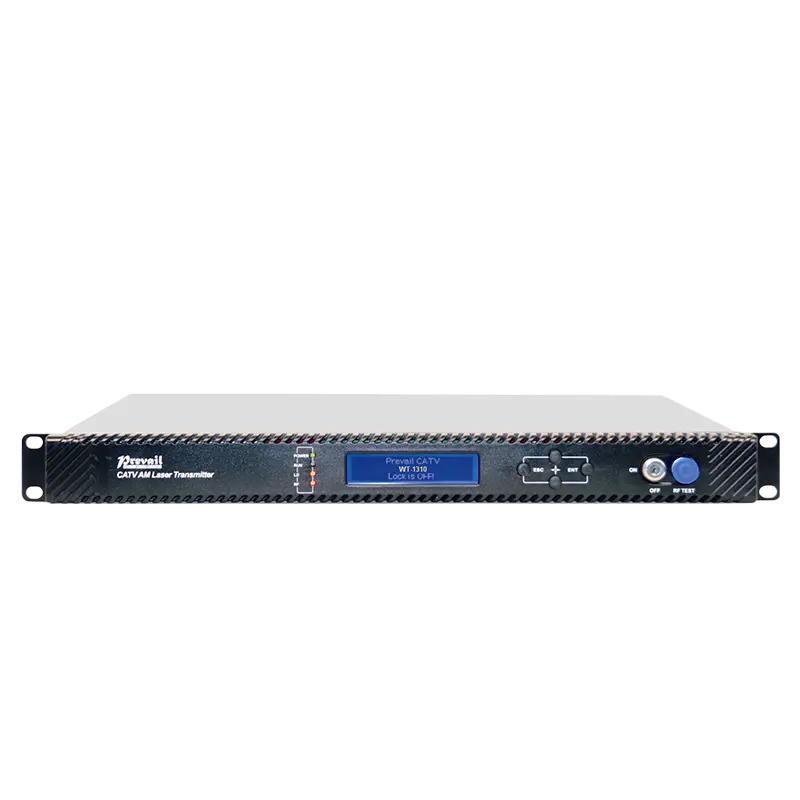
Correct installation of 1310nm transmitters is crucial for achieving optimal performance. Several practical factors must be considered during deployment.
Ensure the transmitter is compatible with the fiber type used in your network. Standard single-mode fiber (SMF-28) is most common for 1310nm links. Multimode fibers are generally not suitable for long-distance 1310nm transmission due to high modal dispersion.
Every connector or splice introduces insertion loss. Using high-quality connectors and precise splicing minimizes loss. Plan your link budget by considering these losses along with the transmitter’s output power to ensure sufficient signal reaches the receiver.
Optical transmitters are sensitive to temperature fluctuations. Operating outside the recommended temperature range can cause wavelength shifts or reduced output power. Choose transmitters rated for the environmental conditions of your deployment site to maintain long-term stability.
The required data rate directly influences the choice of transmitter. For standard Ethernet or telecom links, 1310nm transmitters support 1 Gbps to 10 Gbps or more. Ensure the transmitter supports the desired data rate while maintaining low bit error rates (BER) across the intended distance.
The table below compares common features of 1310nm DFB and FP transmitters for long-distance applications.
| Feature | DFB Transmitter | FP Transmitter |
| Linewidth | Narrow | Broad |
| Transmission Distance | Long (up to 80 km+) | Medium (10–20 km) |
| Output Power | High | Moderate |
| Cost | Higher | Lower |
Reliable long-distance communication requires careful maintenance planning. Regular inspections, monitoring of optical power levels, and proper handling of fiber connections extend transmitter life and ensure consistent performance.
Optical power meters and OTDR (Optical Time-Domain Reflectometer) can detect signal degradation and identify issues such as connector contamination or fiber bends. Proactive monitoring prevents unexpected network downtime.
For mission-critical networks, maintain spare 1310nm transmitters and consider redundant paths. Redundancy ensures continuous operation even if one transmitter fails, reducing maintenance impact on service continuity.
Choosing the right 1310nm optical transmitter for long-distance communication requires a careful balance of output power, receiver sensitivity, modulation type, and distance requirements. DFB transmitters are ideal for extended links and high-speed networks, while FP transmitters are suitable for moderate distances and cost-sensitive applications. By considering environmental factors, installation quality, and maintenance practices, network engineers can ensure reliable and efficient optical communication systems.
top

E-mail:[email protected]

Telphone:+86-15967387077

FAX:+86-0571-82554407

Phone:+86-15967387077
QR code on
mobile phone