English
 русский
 Español
News
Home / News / Industry News / Learn how 1550nm EDFA optical amplifiers work, their applications in fiber networks, key specifications, and selection criteria for optimal performance.

Welcome to Prevail Website! Optical Communication Equipment Manufacturers and Suppliers in China

Content
An Erbium-Doped Fiber Amplifier (EDFA) operating at 1550nm represents one of the most critical components in modern fiber optic communication systems. This specialized device amplifies optical signals directly in the optical domain without requiring conversion to electrical signals, enabling long-distance transmission and complex network architectures that would otherwise be impossible. The 1550nm wavelength corresponds to the C-band of optical communications, where standard single-mode fiber exhibits its lowest attenuation characteristics, making it the preferred wavelength window for long-haul telecommunications, metro networks, and cable television distribution systems.
The fundamental importance of EDFA technology lies in its ability to overcome fiber attenuation limitations that previously restricted transmission distances to approximately 80-100 kilometers before signal regeneration became necessary. Before EDFA deployment became widespread in the 1990s, optical signals required expensive opto-electronic regenerators that converted optical signals to electrical form, amplified and reshaped them electronically, then reconverted to optical signals for continued transmission. EDFAs revolutionized telecommunications by providing all-optical amplification with superior noise performance, wavelength flexibility, and cost-effectiveness. Understanding how these amplifiers function, their technical specifications, and proper implementation strategies is essential for network engineers, system integrators, and telecommunications professionals working with fiber optic infrastructure.
The EDFA operates based on stimulated emission principles similar to those governing laser operation, but configured to amplify existing signals rather than generate new light. The core component consists of a section of optical fiber whose glass matrix has been doped with erbium ions at concentrations typically ranging from 100 to 1000 parts per million. When these erbium ions absorb energy from a pump laser, they transition to excited energy states. As signal photons at 1550nm pass through the erbium-doped fiber, they trigger stimulated emission from the excited erbium ions, releasing additional photons that are coherent with and identical to the signal photons, thereby amplifying the optical signal.
The pump laser provides the energy necessary to excite erbium ions into their amplifying state. Modern EDFAs typically employ semiconductor pump lasers operating at either 980nm or 1480nm wavelengths, each offering distinct advantages. The 980nm pump wavelength provides lower noise figure performance because it excites erbium ions to a higher energy level, resulting in more efficient three-level amplification with minimal spontaneous emission. However, 1480nm pumping offers higher conversion efficiency and generates less heat, making it preferable for high-power applications. Advanced EDFA designs often incorporate both pump wavelengths in dual-stage configurations, using 980nm pumping for the first stage to minimize noise and 1480nm pumping for the output stage to maximize power efficiency.
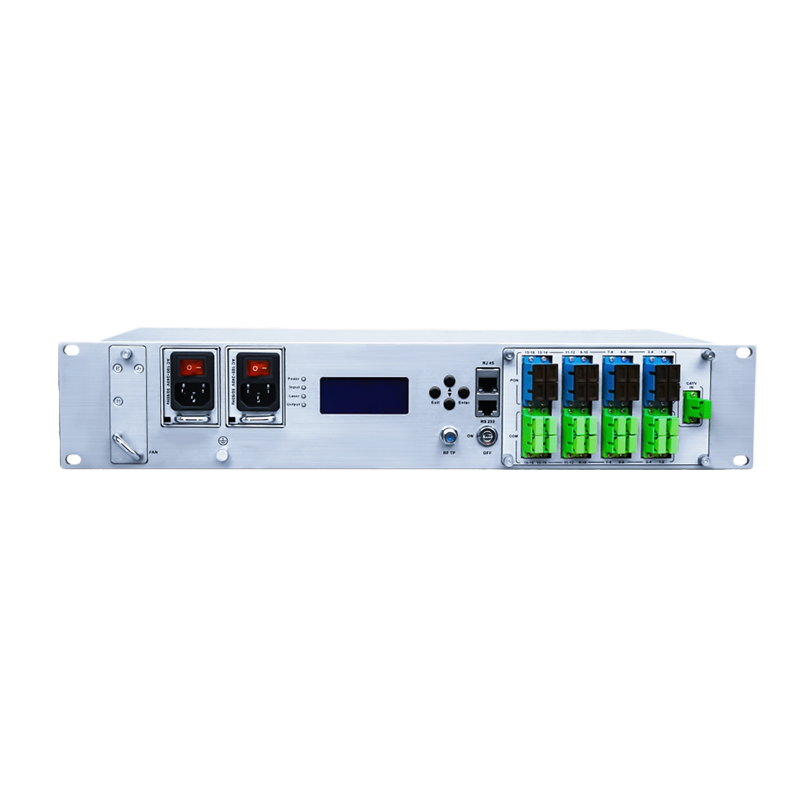
Within the EDFA package, wavelength division multiplexing (WDM) couplers serve the critical function of combining pump light with signal light and separating these wavelengths at appropriate points in the amplifier chain. These passive optical components must exhibit low insertion loss for signal wavelengths while efficiently coupling pump energy into the erbium-doped fiber. High-quality WDM couplers also provide isolation between pump and signal paths, preventing pump light from reaching output ports where it could damage downstream equipment or interfere with system operation. The precision manufacturing of these couplers significantly impacts overall EDFA performance and reliability.
Selecting appropriate EDFA equipment requires understanding the technical specifications that define amplifier performance and how these parameters affect system-level operation. Different applications prioritize different characteristics, making specification comprehension essential for optimal component selection.
| Specification | Typical Range | Application Impact |
| Small Signal Gain | 15-35 dB | Determines amplification capability and span distance |
| Noise Figure | 4-6 dB | Affects signal quality and cascade performance |
| Output Saturation Power | +13 to +23 dBm | Limits maximum signal power and channel count |
| Gain Flatness | ± 0.5 to ± 2 dB | Critical for WDM systems with multiple channels |
| Polarization Dependent Gain | < 0.3 dB | Ensures consistent performance regardless of polarization |
| Operating Wavelength Range | 1530-1565 nm (C-band) | Defines compatible signal wavelengths |
The noise figure specification deserves particular attention as it fundamentally limits the number of amplifiers that can be cascaded while maintaining acceptable signal quality. Each EDFA adds amplified spontaneous emission (ASE) noise to the signal, degrading the optical signal-to-noise ratio (OSNR). In long-haul systems with multiple amplifier stages, cumulative noise can eventually overwhelm the signal, causing unacceptable bit error rates. Premium EDFAs with noise figures approaching the quantum limit of 3 dB enable longer cascades and higher system margins, though they typically command premium pricing reflecting their sophisticated design and manufacturing requirements.
Gain flatness becomes increasingly important in wavelength division multiplexed systems carrying multiple channels across the C-band. Erbium's natural gain spectrum exhibits significant wavelength-dependent variation, with peak gain occurring around 1530nm and reduced gain at longer wavelengths. Without compensation, this non-uniform gain causes channel power imbalances that worsen through cascaded amplifiers, eventually rendering some channels unusable while others exceed equipment power handling limits. Advanced EDFAs incorporate gain-flattening filters—passive optical elements with complementary spectral responses that equalize gain across the operating bandwidth, enabling uniform amplification of dozens of WDM channels simultaneously.
The versatility of 1550nm EDFA technology enables deployment across diverse telecommunications applications, each with specific performance requirements and operational considerations. Understanding these application categories helps in selecting appropriately configured amplifiers and implementing them effectively.
Long-haul fiber optic systems spanning hundreds or thousands of kilometers represent the original and still most demanding application for EDFA technology. These systems require amplifiers with exceptional noise figure performance, high output power capability, and excellent stability over wide temperature ranges and extended operational periods. Submarine cable systems exemplify the ultimate long-haul application, with amplifiers operating continuously for 25 years or more on the ocean floor where service access is essentially impossible. Such extreme reliability requirements drive specialized EDFA designs incorporating redundant pump lasers, enhanced environmental protection, and extensive qualification testing that verifies performance under accelerated aging conditions.
Metropolitan area networks and fiber-to-the-home access systems employ EDFAs in different configurations optimized for shorter distances, lower channel counts, and cost-sensitive environments. Metro EDFAs often sacrifice some noise figure performance in favor of compact packaging, lower power consumption, and reduced cost. Access network applications may use EDFAs as distribution amplifiers, boosting signal power before splitting to multiple endpoints, or as pre-amplifiers improving receiver sensitivity in long-reach passive optical networks. These applications typically involve less demanding cascade scenarios but require reliable performance in uncontrolled environments including outdoor cabinets subject to temperature extremes and potential environmental contamination.
Cable television operators utilize 1550nm EDFAs extensively in hybrid fiber-coaxial (HFC) networks, where optical transmission delivers broadcast and narrowcast signals from headends to neighborhood nodes. CATV applications impose unique requirements including extremely low composite distortion specifications to preserve analog video quality, high output power to support signal splitting for multiple nodes, and specialized modulation formats carrying dozens or hundreds of RF channels. EDFAs for CATV service typically feature linearized designs minimizing intermodulation products, high-power output stages delivering +20 dBm or more, and monitoring capabilities tracking critical parameters that affect service quality.
Modern EDFA products offer numerous configuration options and architectural variations designed to optimize performance for specific applications or operating conditions. Understanding these options enables proper specification and deployment planning.
Successful EDFA deployment requires attention to installation practices, system integration factors, and operational considerations beyond simply selecting appropriate equipment specifications. Proper installation procedures ensure that amplifiers achieve their rated performance and maintain reliability throughout their operational lifetime.
Fiber connection quality critically impacts EDFA performance, particularly regarding back-reflections that can destabilize amplifier operation or cause gain fluctuations. All fiber connections should use angle-polished connectors (APC) rather than physical contact (PC) connectors to minimize back-reflections to levels below -60 dB. Thorough cleaning of connector end-faces before mating and inspection with fiber microscopes prevents contamination-induced losses and reflection points. Poor connections can introduce 1-2 dB of additional loss, directly degrading system margins and reducing achievable span distances.
Power supply considerations affect both performance and reliability. EDFAs require stable DC power, typically -48V in telecommunications applications or 110/220V AC in commercial installations. Power supply noise or voltage fluctuations can modulate pump laser output, introducing amplitude variations in the amplified signal. Quality power supplies with adequate filtering and voltage regulation ensure clean amplifier operation. Redundant power supply configurations protect against single-point failures in critical applications, automatically switching to backup supplies if primary sources fail.
Environmental factors including temperature, humidity, and vibration affect EDFA operation and longevity. While most telecommunications-grade amplifiers specify operating temperature ranges from -5°C to +65°C, performance parameters including gain and noise figure vary somewhat across this range. Temperature-controlled equipment rooms or outdoor cabinets with climate control provide more stable operating conditions, particularly important for systems operating near specification limits. Humidity control prevents condensation that could corrode electrical contacts or degrade optical connections, while vibration isolation protects sensitive optical alignments in high-vibration environments.
Effective monitoring and preventive maintenance programs maximize EDFA operational reliability and enable early detection of developing problems before they cause service-affecting failures. Modern amplifiers incorporate extensive internal monitoring capabilities that provide visibility into operational status and performance trends.
Key parameters requiring regular monitoring include input and output optical power levels, pump laser current and output power, internal temperature readings, and alarm status indicators. Input power monitoring detects fiber breaks or upstream equipment failures, while output power tracking identifies degrading performance or component failures within the amplifier. Pump laser current provides an early warning of degradation—as pump diodes age, they require increasing drive current to maintain constant output power, eventually reaching a point where they can no longer deliver sufficient pump power for proper amplification. Temperature monitoring ensures operation within specifications and can identify environmental control problems or inadequate cooling before they cause failures.
Most EDFAs support remote monitoring via SNMP, Telnet, or proprietary management protocols, enabling centralized visibility from network operations centers. Establishing baseline performance measurements during initial installation provides reference data for trend analysis—gradual degradation in key parameters often indicates developing problems that can be addressed during scheduled maintenance windows rather than through emergency service calls. Regular data collection and analysis help optimize preventive maintenance schedules, replacing components based on actual condition rather than fixed time intervals.
Choosing appropriate EDFA equipment involves balancing technical requirements, budget constraints, and operational considerations specific to each application. A systematic selection process considers all relevant factors to identify optimal solutions.
Begin by calculating link budgets that account for fiber attenuation, passive component losses, required optical signal-to-noise ratio at receivers, and any splitting or branching losses. These calculations determine required amplifier gain and output power specifications. For cascaded amplifier chains, analyze cumulative noise contributions to ensure adequate OSNR margins at final receivers—systems with many amplifier stages require lower noise figure specifications than shorter links. Consider whether the application requires single-channel operation or must support WDM, as multi-channel systems demand gain-flattened amplifiers with carefully specified gain uniformity across the operating bandwidth.
Evaluate operational requirements including physical size constraints, power consumption limits, environmental conditions, and reliability expectations. Compact amplifiers suit rack-mounted telecommunications equipment, while outdoor applications require ruggedized enclosures with wide temperature ranges and environmental sealing. High-reliability applications justify premium amplifiers with redundant components and extended warranty coverage, while cost-sensitive deployments may accept more basic designs with reduced feature sets. Management and monitoring capabilities vary significantly across products—determine whether simple LED status indicators suffice or if comprehensive SNMP integration with alarming and performance monitoring justifies additional investment. By methodically evaluating these factors against application requirements, network planners can identify EDFA solutions that deliver optimal performance and value for their specific deployment scenarios.
top

E-mail:[email protected]

Telphone:+86-15967387077

FAX:+86-0571-82554407

Phone:+86-15967387077
QR code on
mobile phone