XG(S)PON OLT Explained: xPON Broadband Access Equipment Guide
Why XG(S)PON Is Reshaping Data Broadband Access
Passive optical networks have been the backbone of fiber-to-the-home (FTTH) and fiber-to-the-building (FTTB) deployments for over a decade. But as bandwidth demands surge — driven by 4K/8K video streaming, cloud gaming, remote work, and smart home devices — legacy GPON with its 2.5 Gbps downstream capacity is no longer sufficient for densely populated service areas. XG(S)PON steps in as the direct successor, delivering 10 Gbps downstream and either 2.5 Gbps (XG-PON) or 10 Gbps (XGS-PON) upstream over the same existing single-mode fiber infrastructure.
For broadband service providers and ISPs, this transition is not merely a speed upgrade — it fundamentally changes how they architect their access networks. The optical line terminal (OLT), positioned at the central office or aggregation node, is the first piece of data broadband access equipment to be replaced in any xPON migration. Choosing the right OLT determines the scalability, power efficiency, and operational cost of the entire access layer for years to come.
XGS-PON in particular has gained rapid adoption because it offers symmetrical 10G throughput, making it ideal for business broadband services, enterprise leased lines, 5G fronthaul, and residential ultra-broadband bundles. According to the FTTH Council, global PON port shipments for XGS-PON surpassed GPON for the first time in 2023, a trend that is accelerating as operators phase out legacy equipment in favor of 10G-capable platforms.
Inside the Rack-Mounted XG(S)PON OLT: What the Hardware Actually Does
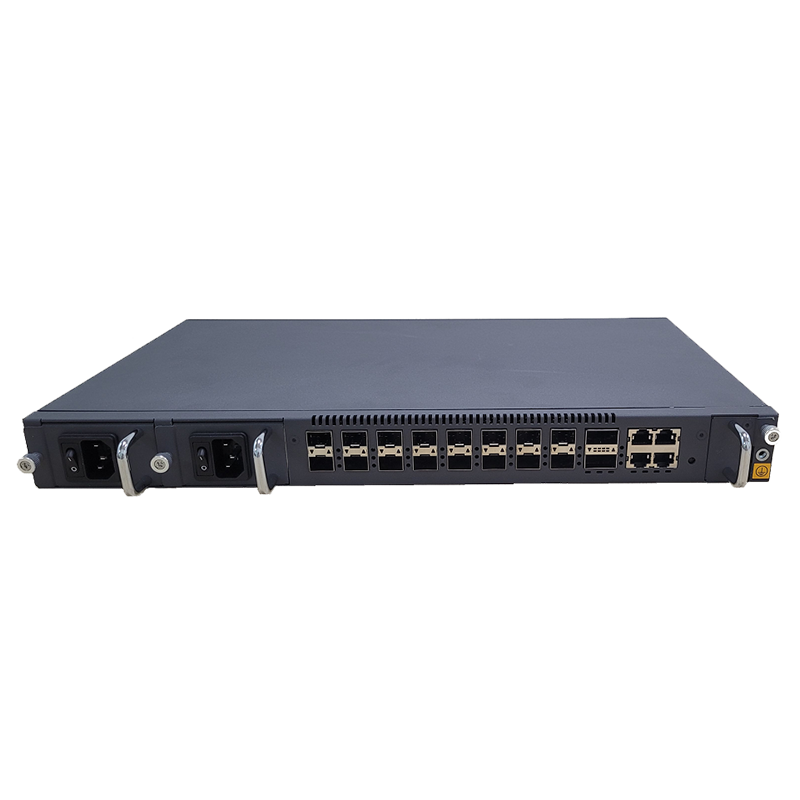
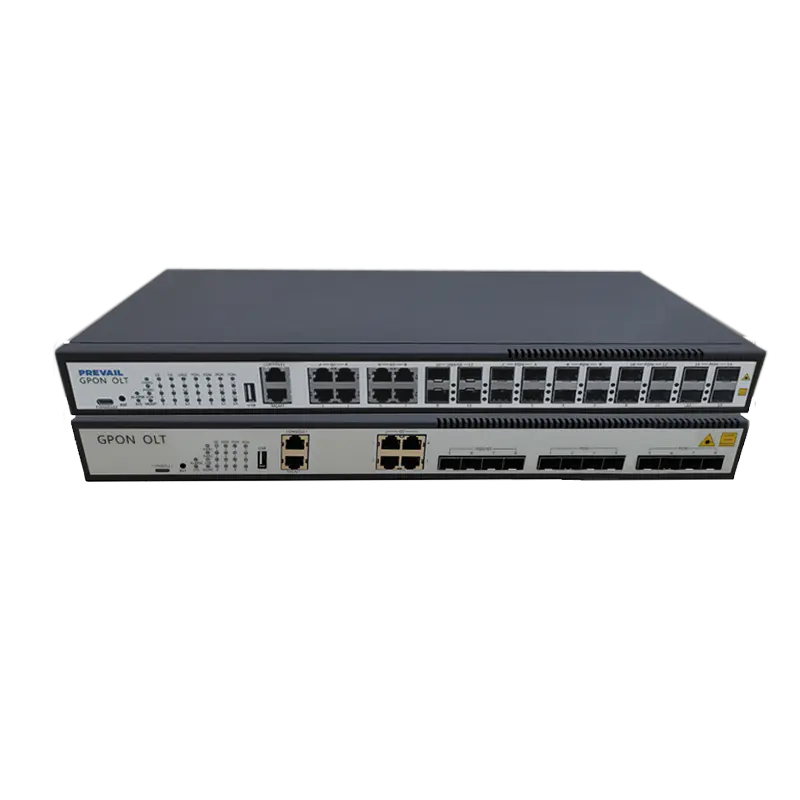
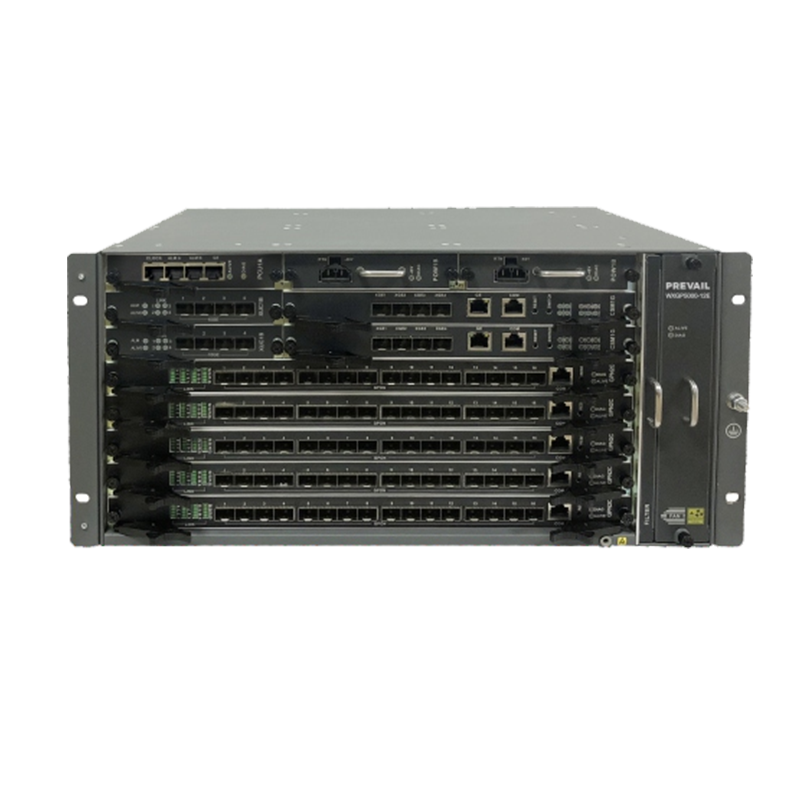
A rack-mounted XG(S)PON OLT like the WXGP5000-05E is a carrier-grade chassis designed to aggregate traffic from hundreds or even thousands of optical network units (ONUs) distributed across a service area. Unlike smaller pizza-box OLTs used in micro-CO deployments, a rack-mounted form factor is engineered for high-density, high-availability central office environments where redundancy and slot expansion are non-negotiable.
The chassis typically houses multiple PON line cards — each card carrying 8 or 16 XG(S)PON ports — along with uplink cards that connect the OLT to the metro or core network via 10GE, 25GE, or 100GE interfaces. A central switching fabric handles traffic aggregation internally, while dedicated control cards manage OMCI (ONT Management and Control Interface) signaling, IGMP snooping for multicast IPTV, and DBA (Dynamic Bandwidth Allocation) for real-time upstream scheduling.
The WXGP5000-05E rack-mounted XG(S)PON OLT is built around a modular slot architecture that allows operators to mix PON cards and uplink cards within the same chassis. This flexibility is critical during network migration: an operator can populate early slots with XGS-PON cards for new subscribers while retaining GPON cards in remaining slots for legacy ONTs — avoiding a costly "forklift upgrade" that replaces all subscriber terminals simultaneously.
Key Hardware Components
- PON Line Cards: Each XG(S)PON card supports 10 Gbps downstream per port and up to 128 ONTs per port via a 1:128 split ratio, maximizing subscriber density per card slot.
- Uplink Cards: Multi-rate uplink modules (10GE/25GE/100GE) ensure the OLT can be connected to any generation of metro Ethernet or IP/MPLS aggregation equipment without additional transponders.
- Redundant Control Boards: 1+1 hot-standby control card redundancy ensures zero-downtime switchover in the event of a card failure, meeting carrier-class availability targets of 99.999%.
- Dual PSUs: Hot-swappable power supply units with AC/DC input options and N+1 redundancy prevent service interruption during maintenance or power anomalies.
GPON vs XG(S)PON: A Side-by-Side Comparison for Access Planners
Before deploying any new data broadband access equipment, network planners need a clear picture of the differences between GPON and XG(S)PON at the technical level. The table below summarizes the most relevant parameters for access network engineers evaluating a migration path.
| Parameter |
GPON |
XG-PON (10G/2.5G) |
XGS-PON (10G/10G) |
| Downstream Rate |
2.488 Gbps |
9.953 Gbps |
9.953 Gbps |
| Upstream Rate |
1.244 Gbps |
2.488 Gbps |
9.953 Gbps |
| Max Split Ratio |
1:128 |
1:128 |
1:128 |
| Downstream Wavelength |
1490 nm |
1577 nm |
1577 nm |
| Coexistence with GPON |
Native |
Via WDM filter |
Via WDM filter |
| Typical Use Case |
Residential FTTH |
Hybrid migration |
Business & ultra-broadband |
Table 1: Technical comparison of GPON, XG-PON, and XGS-PON for broadband access planning
One of the most strategically important rows in this table is coexistence with GPON. Since XG(S)PON uses a different wavelength window than GPON, deploying a combo OLT that supports both simultaneously on the same ODN requires a passive WDM coexistence element (CE) spliced at the feeder fiber. The WXGP5000-05E supports this architecture natively, allowing operators to serve both GPON and XGS-PON ONTs from a single fiber plant without splitting the ODN into separate trees.
Real-World Deployment Scenarios for xPON OLT Equipment
Understanding where and how a rack-mounted XG(S)PON OLT fits into the network is essential for accurate Bill of Materials planning and for avoiding over-engineering or under-provisioning at the access layer.
Scenario 1: Greenfield FTTH for Large Residential Developments
In a greenfield deployment serving a new housing estate of 2,000 to 5,000 homes, an operator can deploy the WXGP5000-05E fully populated with XGS-PON line cards from day one. With 16 PON ports per card and a 1:64 split ratio, a single fully loaded chassis can serve over 2,000 ONTs while leaving headroom on each PON port for future subscriber growth. The uplink side connects to a 100GE metro aggregation switch, delivering sufficient backplane capacity even at peak traffic hours.
Scenario 2: GPON-to-XGS-PON Migration in an Existing Central Office
For operators upgrading an existing GPON network, a chassis that supports mixed PON card types is the most practical solution. An operator replaces aging GPON OLTs with the WXGP5000-05E while retaining existing ODN infrastructure and ONTs. New high-bandwidth subscribers — particularly those demanding 1 Gbps symmetric service — are provisioned on XGS-PON cards, while existing customers remain on GPON cards within the same chassis. Over 24 to 36 months, GPON cards are gradually replaced as ONTs are swapped at the subscriber premises during routine maintenance visits.
Scenario 3: 5G Fronthaul and Fixed-Wireless Convergence
Mobile network operators and converged carriers are increasingly using XGS-PON to carry 5G fronthaul traffic from radio units (RUs) to distributed units (DUs) in O-RAN architectures. The tight latency requirements of 5G fronthaul — typically below 100 µs one-way — demand precise timing synchronization. Enterprise-grade rack-mounted OLTs support IEEE 1588v2 PTP (Precision Time Protocol) and SyncE (Synchronous Ethernet) to distribute accurate time references across the PON tree, satisfying both mobile fronthaul and residential broadband requirements from shared infrastructure.
How to Evaluate an XG(S)PON OLT Before You Commit
With multiple vendors offering rack-mounted XG(S)PON OLT platforms, procurement teams need a structured evaluation framework that goes beyond headline port counts. The following criteria reflect the most common failure points operators encounter after deployment.
- DBA Algorithm Quality: Dynamic Bandwidth Allocation directly impacts user-perceived upstream latency. Ask vendors for benchmark results under mixed traffic loads (best-effort + T-CONT type 2 assured bandwidth), not just peak throughput figures.
- OMCI Stack Compliance: A fully ITU-T G.988 compliant OMCI stack ensures interoperability with ONTs from multiple manufacturers, giving operators procurement flexibility rather than single-vendor lock-in at the subscriber edge.
- Management Plane Maturity: NETCONF/YANG and OpenConfig support are now table stakes for operators running automated provisioning workflows. Verify that the OLT vendor's NMS or EMS supports zero-touch provisioning (ZTP) for ONT onboarding.
- Power Consumption per Port: In large central offices, OLT power draw directly affects OPEX through electricity costs and cooling infrastructure. Compare watts-per-PON-port across vendors — differences of 20–30% are common and compound significantly across a fleet of dozens of chassis.
- Software Upgrade Track Record: Fiber access infrastructure has a 10–15 year lifecycle. Verify that the vendor has a documented cadence of firmware updates addressing security CVEs and feature backports, and confirm whether software upgrades require traffic-impacting reboots or support in-service software upgrade (ISSU).
Finally, always request a lab trial or proof-of-concept deployment with actual ONT models you plan to use in the field. Interoperability testing between an OLT like the WXGP5000-05E and third-party ONTs under realistic traffic conditions — including multicast IPTV, VoIP QoS marking, and DHCP snooping — will surface integration issues that specification sheets never reveal. A 4-to-8 week trial period is standard practice for any carrier-class broadband access equipment procurement.
Planning Your xPON Network for Long-Term Scalability
The decision to deploy a rack-mounted XG(S)PON OLT is as much a strategic infrastructure commitment as it is a technical one. Operators who plan their xPON rollout with future capacity in mind — accounting for subscriber growth, service tier evolution, and potential 50G PON migration pathways — will extract significantly more value from their capital investment than those who optimize only for the lowest per-port cost at the time of purchase.
The ITU-T is already finalizing standards for 50G PON (ITU-T G.9804 series), and several OLT vendors are designing current hardware with upgrade paths to 50G line cards within the same chassis. When evaluating data broadband access equipment today, confirm whether the chassis backplane and control architecture can accommodate next-generation PON cards — this single factor can determine whether a chassis deployed in 2025 remains serviceable through 2035 or requires a full replacement mid-lifecycle.
Ultimately, the OLT is the most consequential node in any fiber access network. Its hardware architecture, software ecosystem, and vendor support trajectory will shape the subscriber experience, operational efficiency, and competitive positioning of an ISP for the next decade. Investing the time to evaluate it thoroughly — rather than defaulting to the lowest-price bid — is one of the highest-return decisions a network operator can make.


 English
 русский
 Español