English
 русский
 Español
What Is a 1550nm EDFA Optical Amplifier and Why Does the Wavelength Matter?
An EDFA — Erbium-Doped Fiber Amplifier — is an optical amplifier that boosts the power of light signals traveling through a fiber optic network without converting them to electrical form first. The amplification occurs entirely in the optical domain: a section of silica fiber doped with erbium ions is pumped with laser light, typically at 980 nm or 1480 nm, which excites the erbium atoms to a higher energy state. When signal photons at 1550 nm pass through this active fiber, they stimulate the excited erbium ions to release identical photons — same wavelength, same phase, same direction — producing gain through stimulated emission. The result is a transparent amplification process that can boost signals by 20 to 40 dB with noise figures as low as 3 to 5 dB.
The 1550 nm wavelength is not arbitrary. It sits at the center of the C-band (1530–1565 nm) and L-band (1565–1625 nm) transmission windows, where standard single-mode silica fiber exhibits its lowest attenuation — approximately 0.2 dB/km. This means signals at 1550 nm travel farther before needing amplification than at any other wavelength in the infrared range. The coincidence of erbium's peak gain spectrum with this low-loss transmission window is what made EDFA technology transformative for long-haul optical communications, and it remains the reason 1550 nm EDFA amplifiers are the dominant active component in backbone fiber networks worldwide.
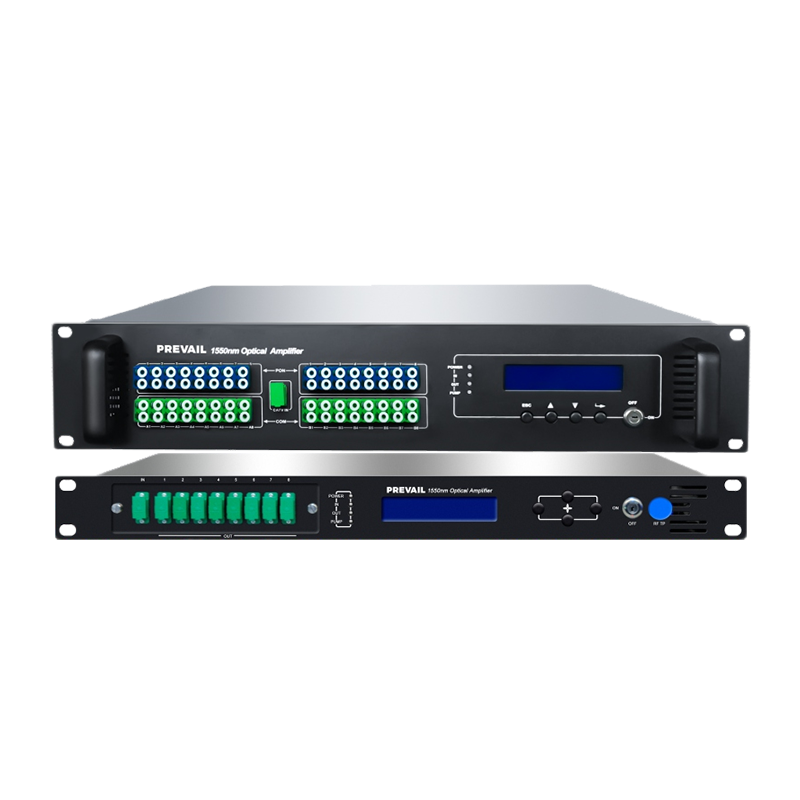
How a 1550nm EDFA Works: Internal Architecture
The core of any 1550 nm EDFA is the erbium-doped fiber (EDF) itself — a coiled section of specially fabricated fiber typically ranging from 5 to 30 meters in length, with erbium ion concentrations carefully controlled during preform manufacturing to achieve the target gain coefficient. The EDF is spliced into the signal path and co- or counter-pumped with a high-power semiconductor pump laser. The choice between co-propagating (forward) pumping at 980 nm and counter-propagating (backward) pumping at 1480 nm involves a trade-off: 980 nm pumping produces lower noise figures, making it preferred for the first amplification stage after a long span; 1480 nm pumping is more efficient in terms of pump-to-signal power conversion and is often used in booster and in-line amplifier configurations.
A wavelength-division multiplexing (WDM) coupler combines the pump and signal wavelengths onto the same fiber before they enter the EDF. An isolator placed at the input prevents back-reflected light from destabilizing the gain medium or upstream laser sources. A second isolator at the output blocks amplified spontaneous emission (ASE) from propagating backward into the network. Many commercial units also include a gain-flattening filter (GFF) — a carefully designed passive filter that compensates for erbium's non-uniform gain spectrum, ensuring all WDM channels within the C-band receive approximately equal amplification. Without gain flattening, channels near 1532 nm and 1550 nm would be amplified more strongly than channels near the band edges, accumulating a gain tilt that compounds over multiple amplifier stages in a long-haul system.
Key Internal Components of a 1550nm EDFA
- Erbium-Doped Fiber (EDF): The active gain medium. Length, doping concentration, and core geometry determine the gain coefficient, saturation power, and noise characteristics of the amplifier.
- Pump Laser Diode: Typically a 980 nm or 1480 nm single-mode laser with output power ranging from 50 mW to over 500 mW depending on the target gain and output power specification.
- WDM Coupler: Combines pump and signal on a single fiber with minimal insertion loss at both wavelengths, typically less than 0.5 dB on the signal path.
- Optical Isolators: Placed at input and output to prevent parasitic lasing and protect adjacent components from backward-propagating ASE or reflections.
- Gain-Flattening Filter (GFF): A wavelength-selective loss element that equalizes gain across the C-band, essential for multi-channel DWDM systems.
- Tap Couplers and Photodetectors: Monitor input and output power levels, enabling automatic gain control (AGC) or automatic level control (ALC) feedback loops.
- Control Electronics: Regulate pump laser current to maintain constant gain or constant output power, and provide alarms and telemetry via management interfaces such as I²C, RS-232, or SNMP over Ethernet.
EDFA Amplifier Configurations: Booster, In-Line, and Preamplifier
1550 nm EDFAs are deployed in three distinct positions within a fiber link, and each position imposes different requirements on the amplifier's key parameters. Understanding these configurations is essential for selecting the right unit for a specific network role.
| Configuration | Position in Link | Primary Requirement | Typical Output Power |
| Booster (Post-Amplifier) | Immediately after transmitter | High output power, moderate NF | +17 to +33 dBm |
| In-Line Amplifier (ILA) | Mid-span, every 60–100 km | Balanced gain and noise figure | +13 to +23 dBm |
| Preamplifier | Immediately before receiver | Ultra-low noise figure | 0 to +10 dBm |
Booster amplifiers are designed to launch the highest possible power into a long fiber span. They receive a well-conditioned signal from the transmitter and must saturate efficiently to deliver output powers of +20 dBm or more into the fiber. Because the signal-to-noise ratio entering the booster is high, a moderate noise figure — typically 5 to 7 dB — is acceptable. In-line amplifiers must balance gain against noise accumulation, since each successive ILA in a chain adds ASE noise that compounds along the link. Preamplifiers face the most demanding noise requirements because they receive the weakest signals — those that have traveled the full span from the last amplifier — and must amplify them to a level the receiver can process with adequate optical signal-to-noise ratio (OSNR).
Key Performance Specifications and What They Mean in Practice
When evaluating 1550 nm EDFA datasheets, several parameters appear consistently and require accurate interpretation to make a valid comparison between products.
Gain (dB) describes the ratio of output signal power to input signal power, expressed logarithmically. A 30 dB gain amplifier multiplies signal power by a factor of 1,000. However, the gain figure only has meaning in the context of the input power range over which it is specified — gain compression occurs as input power increases and the amplifier approaches saturation, so always verify whether the stated gain applies at small-signal (linear) conditions or at the rated output power point.
Noise Figure (NF, dB) quantifies the degradation of the signal-to-noise ratio caused by the amplification process. The theoretical minimum noise figure for a phase-insensitive optical amplifier is 3 dB, corresponding to the quantum limit set by spontaneous emission. Practical 1550 nm EDFAs achieve noise figures of 3.5 to 5 dB for preamplifier configurations and 5 to 7 dB for booster configurations. In a cascaded amplifier chain, the total system OSNR is dominated by the noise contribution of the first amplifier — which is why minimizing NF at the first stage matters more than at subsequent stages.
Output Power Saturation (Psat, dBm) is the maximum output power the amplifier can deliver before gain begins to compress significantly. For DWDM booster applications carrying many channels simultaneously, the total output power is shared among all channels — a +23 dBm booster carrying 40 channels delivers approximately +7 dBm per channel. Verify that the per-channel power at the amplifier output is compatible with fiber nonlinearity thresholds and downstream component power ratings.
Primary Applications of 1550nm EDFA Amplifiers
- Long-Haul and Ultra-Long-Haul Transmission: Submarine cables and terrestrial backbone networks use cascaded EDFA chains — sometimes hundreds of amplifiers in series — to carry 100G, 400G, and beyond capacity over thousands of kilometers without electrical regeneration.
- DWDM Metro and Regional Networks: In-line EDFAs compensate for the accumulated loss of fiber spans, multiplexers, switches, and add-drop nodes in metropolitan area networks, allowing operators to extend reach and add channels without deploying new fiber infrastructure.
- CATV and Fiber-to-the-Home (FTTH) Distribution: High-output booster EDFAs at +30 dBm and above amplify downstream optical signals before they are split across large passive optical splitter trees, allowing a single transmitter to serve hundreds or thousands of subscribers in HFC and GPON architectures.
- Optical Sensing and LIDAR: Pulsed 1550 nm EDFA amplifiers are used to boost the output of seed lasers in long-range LIDAR systems, distributed acoustic sensing (DAS) along pipelines and railways, and fiber Bragg grating interrogation systems where the 1550 nm wavelength offers eye-safe operation at high peak powers.
- Test and Measurement: Variable-gain EDFAs serve as controlled optical power sources in component test setups, OSNR margin testing, and receiver sensitivity characterization, providing clean amplified signals across the C-band with precisely adjustable output levels.
Selecting the Right 1550nm EDFA: Practical Checklist
Specifying a 1550 nm EDFA for a real deployment involves matching the amplifier's parameters to the link budget requirements rather than simply selecting the highest-gain or highest-power unit available. Overdriving an EDFA beyond its rated input power range causes gain compression and degrades OSNR; operating it at too low an input level wastes pump power and increases relative intensity noise in the output.
Start by calculating the span loss — the total insertion loss in dB from the amplifier's output to the next amplifier's input, accounting for fiber attenuation at 0.2 dB/km, connector and splice losses, and the insertion loss of any passive components such as ROADMs, optical switches, or fiber patch panels in the path. The in-line amplifier's gain must at minimum equal this span loss to maintain constant signal level through the link. Add margin for aging and repair splices, typically 3 to 6 dB depending on network design standards.
For DWDM applications, confirm that the EDFA's operating bandwidth covers all deployed channels and that the gain flatness specification — typically ±0.5 to ±1.5 dB across the C-band — is tight enough to prevent channel power excursions from accumulating to unacceptable levels over the number of amplifier stages in the path. Gain tilt accumulation is one of the most common causes of reduced margin in installed DWDM systems, and it is almost always traceable back to inadequate gain flatness specification at the amplifier selection stage.