English
 русский
 Español
News
Home / News / Industry News / What Role Does an Indoor Optical Receiver Play in HFC Transmission Networks?

Welcome to Prevail Website! Optical Communication Equipment Manufacturers and Suppliers in China

Content
Hybrid Fiber-Coaxial (HFC) is the dominant network architecture used by cable television operators and broadband service providers worldwide to deliver video, internet, and voice services to residential and commercial subscribers. In an HFC network, optical fiber carries signals from the headend or hub site to a node located in the serving area — typically within one to three kilometers of the end subscribers. At the node, the optical signal is converted back into an RF (radio frequency) electrical signal and distributed to subscribers over coaxial cable. The indoor optical receiver is the equipment that performs this critical optical-to-RF conversion, and in modern HFC deployments, this device sits at the boundary between the fiber backbone and the coaxial distribution plant.
Unlike outdoor optical nodes mounted on utility poles or in underground enclosures, indoor optical receivers are designed for installation in controlled environments — equipment rooms, headend facilities, multi-dwelling unit (MDU) distribution frames, and hotel or hospital IQ cabinets. Their form factor, power supply design, and connector interfaces reflect these installation conditions. Understanding how they function within the overall HFC architecture is essential before evaluating specific product series or technical specifications.
The core function of an indoor optical receiver is optoelectronic conversion — transforming a modulated optical signal carried on a single-mode fiber into a broadband RF signal suitable for coaxial cable distribution. The process begins when the optical signal, typically carried at 1310 nm or 1550 nm wavelength, enters the receiver through an SC/APC or FC/APC optical connector. The signal passes to a PIN photodiode or avalanche photodiode (APD), which converts the optical power variations into a corresponding electrical current. This current is then amplified by a transimpedance amplifier (TIA) and subsequent RF amplifier stages to produce an output RF signal at the required power level and frequency range.
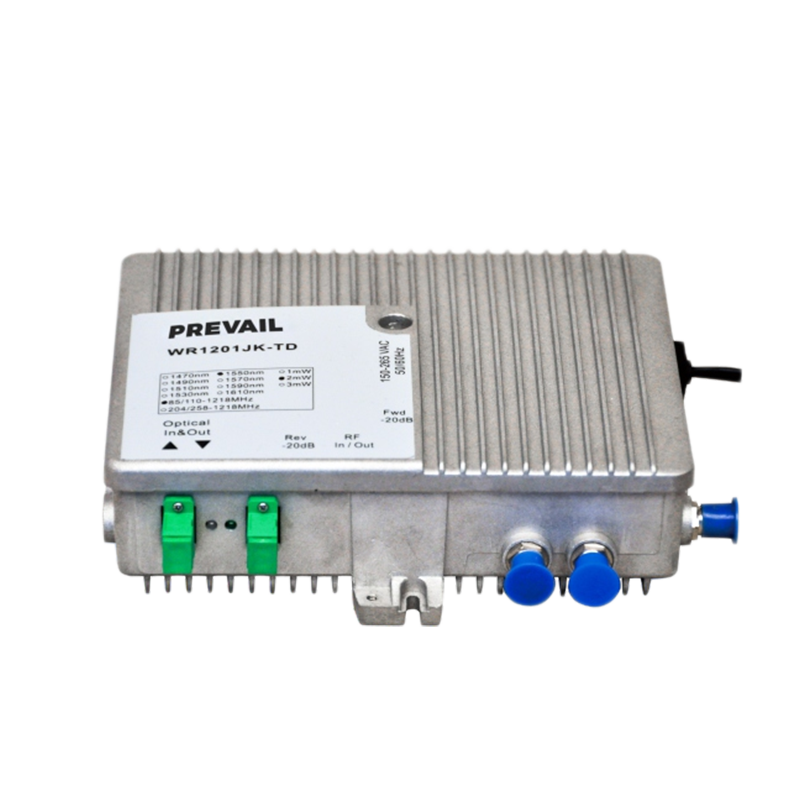
Modern indoor optical receivers for HFC applications support downstream frequency ranges from 47 MHz to 1218 MHz — or in DOCSIS 3.1 and emerging extended spectrum configurations, up to 1794 MHz — to accommodate both legacy analog video channels and high-capacity digital services including DOCSIS broadband and IPTV. Many units also support return path (upstream) capability, allowing subscriber signals to travel back toward the headend over a separate upstream optical transmitter integrated into the same housing. The automatic gain control (AGC) circuit within the receiver monitors and stabilizes the RF output level as input optical power fluctuates, maintaining consistent signal delivery across varying fiber link conditions.
Selecting the right indoor optical receiver series for an HFC deployment requires careful evaluation of several interdependent technical parameters. Each specification directly influences system performance and the receiver's compatibility with the broader network design.
The receiver's input optical power range defines the span of optical signal levels over which the unit can operate within its specified RF output performance. A typical indoor optical receiver accepts input levels from -7 dBm to +2 dBm, though high-sensitivity models may extend this range down to -10 dBm or lower. The AGC circuit manages output stability across this range, but operating consistently at the boundaries — especially at very low input levels — degrades carrier-to-noise ratio (CNR) and should be avoided in link budget planning. The receiver's noise figure and CNR specification are directly tied to the optical input level at which they are measured.
RF output level, expressed in dBmV or dBµV, determines how far the converted signal can travel through the downstream coaxial distribution network before requiring amplification. Indoor receivers used in MDU or hotel environments typically deliver output levels of 100 to 116 dBµV across the forward frequency band. Output flatness — how evenly power is distributed across the full frequency range — is equally important. A frequency response slope or tilt across the output band will cause downstream signal delivery to be uneven, with higher frequencies arriving weaker than lower ones. Premium indoor receiver series specify flatness within ±0.75 dB or better across the full operating bandwidth.
CNR is the single most important signal quality metric in HFC systems and is the primary indicator of how cleanly the optical receiver converts the incoming signal without introducing noise that degrades digital modulation quality. Indoor optical receivers for DOCSIS and digital video applications typically specify CNR values of 50 dB or higher at a nominal input optical power of 0 dBm. As input optical power decreases, CNR degrades — roughly 1 dB of CNR is lost for every 1 dB decrease in input optical power. System designers must ensure that the minimum CNR at the receiver output, after accounting for the full coaxial distribution network, remains above the minimum threshold required by the modulation scheme in use — 35 dB for 256-QAM and 42 dB for 1024-QAM, for example.
In a bidirectional HFC system, the indoor optical receiver must also handle the upstream signal path. Many indoor receiver series integrate a return path optical transmitter operating at 1310 nm with a typical upstream frequency range of 5 to 85 MHz for legacy DOCSIS 3.0 systems, or 5 to 204 MHz for extended spectrum DOCSIS 3.1 and future mid-split or high-split configurations. The return path transmitter converts the upstream RF signal collected from the coaxial plant back into an optical signal for transmission to the headend. Return path performance — including upstream CNR, spurious emission levels, and optical output power — should be specified and verified alongside downstream parameters during system commissioning.
| Parameter | Entry-Level Series | Standard Series | High-Performance Series |
| Forward Frequency Range | 47 – 862 MHz | 47 – 1000 MHz | 47 – 1218 MHz |
| Input Optical Power | -3 to +2 dBm | -6 to +2 dBm | -8 to +2 dBm |
| RF Output Level | 100 dBµV | 104 dBµV | 108 – 116 dBµV |
| CNR @ 0 dBm Input | ≥ 50 dB | ≥ 52 dB | ≥ 54 dB |
| Return Path | Optional | 5 – 85 MHz | 5 – 204 MHz |
| RF Output Ports | 1 – 2 | 2 – 4 | 4 – 8 |
| Management | None | Local LED indicators | SNMP / Web GUI / NMS |
Indoor optical receivers are deployed across several distinct network scenarios, each with specific requirements that influence product selection. In multi-dwelling unit (MDU) environments — apartment buildings, condominiums, and gated communities — indoor receivers are installed in building equipment rooms or telecommunications closets. The receiver feeds multiple RF output ports that connect to a passive splitter network serving individual apartments. In these deployments, high RF output level and low noise are critical because the signal must traverse the building's internal wiring to reach each unit without external amplification.
In hotel and hospitality installations, indoor optical receivers serve guest room television and internet distribution systems. The requirement for centralized management — knowing the operational status of every receiver in the property from a single network management system — makes SNMP-capable high-performance series the standard choice. Hospitals and enterprise campuses with private HFC distribution systems have similarly stringent reliability and manageability requirements. In headend or hub facilities where signal is distributed to multiple downstream fiber nodes via optical splitting, indoor receivers configured as sub-splitting amplification points allow the signal to serve larger geographic areas from a central location.
Correct installation is essential for achieving the signal quality and longevity that indoor optical receivers are designed to deliver. Following proven best practices from the initial equipment rack layout through final commissioning prevents the majority of performance problems encountered in the field.
Indoor optical receivers require relatively little routine maintenance compared to outdoor HFC equipment, but periodic inspections and proactive monitoring are important for sustaining long-term performance. Optical connectors should be re-inspected and cleaned at least annually, or whenever signal quality measurements indicate degradation that cannot be attributed to other causes. Firmware updates provided by the manufacturer should be applied to managed receiver units to ensure compatibility with evolving network management systems and to benefit from performance improvements.
When troubleshooting signal quality problems downstream of an indoor optical receiver, work systematically from the optical input toward the RF output. First confirm optical input power is within specification. Then measure RF output level and CNR directly at the receiver output ports before investigating the coaxial distribution plant. This approach isolates whether the receiver itself or the downstream coaxial network is the source of degradation, avoiding unnecessary equipment replacements.
Looking ahead, the HFC industry's migration toward extended spectrum DOCSIS (ESD), mid-split, high-split, and eventually full-duplex configurations will require indoor optical receivers capable of supporting wider upstream frequency ranges and higher downstream bandwidths. Operators planning new MDU or enterprise installations should evaluate whether current high-performance series models support upgrade paths to extended spectrum operation — either through field-upgradeable modules or software configuration — to protect the infrastructure investment against near-term technology evolution requirements.
top

E-mail:[email protected]

Telphone:+86-15967387077

FAX:+86-0571-82554407

Phone:+86-15967387077
QR code on
mobile phone